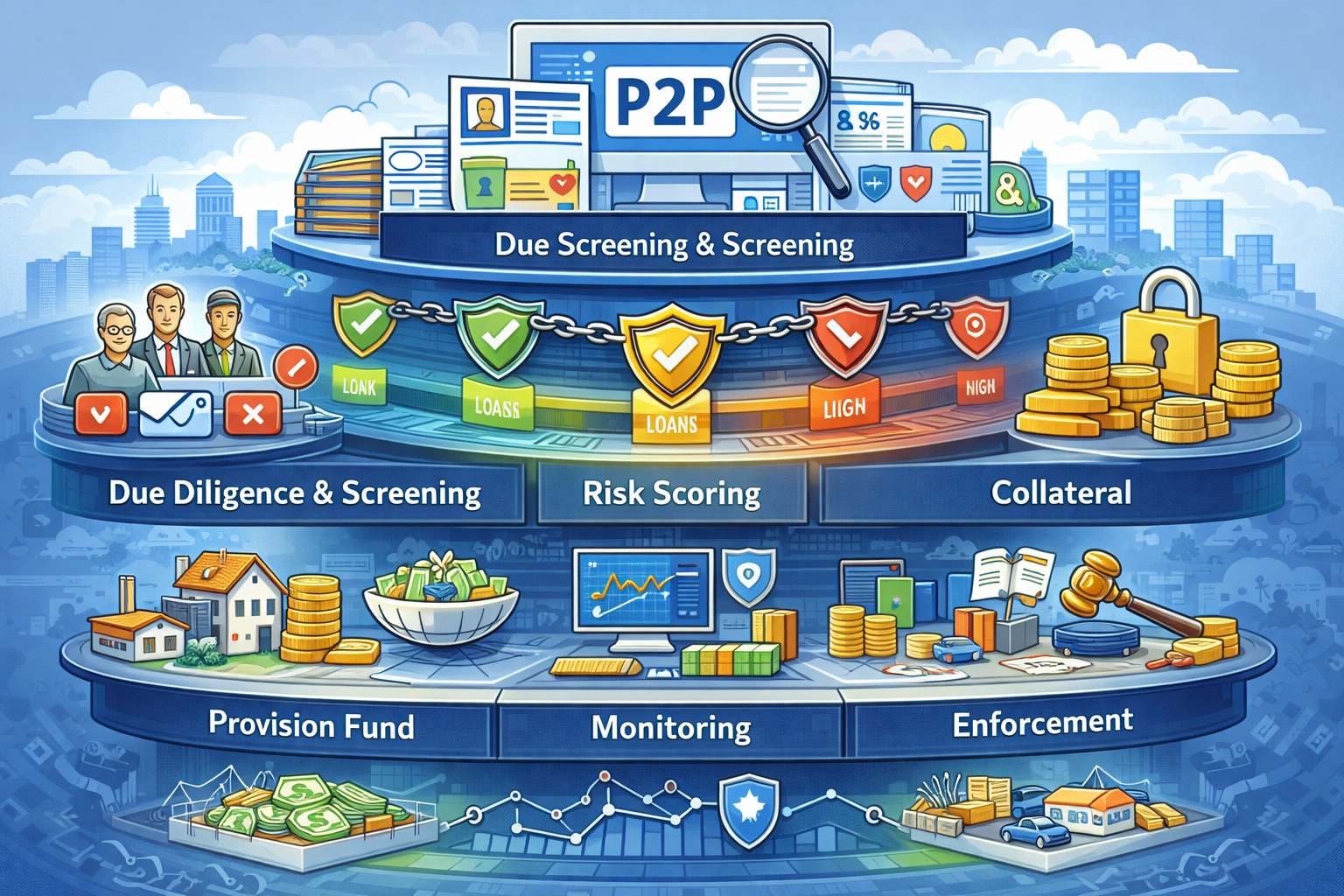
Peer-to-peer lending connects capital with borrowers, but between them stands the platform — a risk intermediary. Its real function is not listing loans but filtering them, structuring them, and protecting investor capital when conditions deteriorate. Stable results usually come from disciplined screening, continuous monitoring, and transparent risk control rather than from attractive headline yields.
Loan Screening as the First Defensive Layer
Loan screening is the entry barrier that determines portfolio quality. Before any project is listed, structured platforms conduct multi-layer due diligence, verifying financial health, ownership structure, repayment capacity, and business sustainability.
This reduces the probability of default at the earliest stage rather than attempting to compensate later with higher returns.
Modern screening combines quantitative analysis — such as debt ratios, cash flow stability, and historical performance — with qualitative evaluation, including management credibility and operational resilience. Weak borrowers are filtered out before reaching investors, improving overall portfolio stability.
Risk Scoring and Predictability of Returns
Risk scoring transforms borrower data into measurable credit profiles. Instead of viewing loans individually, investors see them as components of a structured portfolio where risk is categorized and controlled. Internal ratings often reflect financial strength, collateral coverage, and repayment reliability.
Predictability is the real value of scoring systems. Investors who understand risk distribution can balance yield and stability, building portfolios designed for consistent income rather than volatile performance.
| Risk Level | Typical Borrower Profile | Expected Yield | Default Probability | Stability Outlook |
|---|---|---|---|---|
| Low Risk | Established, stable cash flow | 6–9% | Low | Very Stable |
| Medium Risk | Growing, moderate leverage | 10–13% | Moderate | Stable |
| Higher Risk | Expansion phase, higher leverage | 14%+ | Elevated | Volatile |
Collateral and Downside Protection
Defaults are an inherent part of lending, making recovery mechanisms essential.
Collateral, guarantees, and pledged assets create a secondary layer of protection, allowing value recovery even when borrowers fail to meet obligations. Structured platforms follow defined recovery sequences: monitoring, restructuring attempts, enforced collection, and collateral realization.
Recovered funds are typically distributed proportionally among investors, converting potential loss into controlled risk rather than uncontrolled volatility. Capital protection embedded within loan architecture is a key indicator of platform maturity.
Provision Mechanisms and Cash Flow Stability
Provision or reserve funds serve as liquidity buffers during temporary borrower disruptions. They help maintain scheduled interest payments while the platform evaluates borrower recovery. These mechanisms do not eliminate risk but smooth income volatility, improving predictability of investor cash flow.
Understanding how provision funds operate — whether they cover interest only or also principal, how they are financed, and when they activate — is critical for evaluating their real protective value.
| Protection Layer | Role in Risk Control | Impact on Investors |
|---|---|---|
| Due Diligence & Screening | Filters weak borrowers | Reduces default probability |
| Risk Scoring | Categorizes exposure | Improves predictability |
| Collateral & Guarantees | Enables recovery | Protects principal |
| Provision Fund | Stabilizes payouts | Smooths cash flow |
| Monitoring & Enforcement | Controls lifecycle risk | Limits downside |
Continuous Monitoring and Lifecycle Risk Control
Risk management continues long after funding. Structured platforms monitor borrower performance, detect early warning signals, and intervene when necessary.
Financial deterioration, payment delays, or operational changes may trigger corrective actions aimed at preserving both borrower viability and investor capital.
Active monitoring transforms lending from passive exposure into managed credit. This ongoing oversight is a major contributor to stable long-term performance.
Transparency as a Protective Mechanism
Transparency reduces uncertainty, and reduced uncertainty improves investor confidence.
Platforms that openly publish repayment statistics, performance metrics, and risk methodologies allow investors to evaluate real stability rather than marketing narratives.
Disclosure of defaults, recovery outcomes, and fund usage signals operational discipline.
Opaque systems increase perceived risk regardless of actual performance, making transparency itself a form of investor protection.
Core Signals of Strong Risk Control
When evaluating a platform, investors typically focus on several structural indicators:
- Multi-layer loan screening and borrower due diligence
- Internal risk scoring and portfolio classification
- Collateral-backed lending with recovery procedures
- Provision or reserve mechanisms supporting payout continuity
- Ongoing monitoring and transparent performance reporting
Together, these signals indicate whether the platform is engineered for long-term stability rather than short-term growth.
Structured Risk Control in Practice — The Maclear Model
Structured European crowdlending platforms demonstrate how layered risk control can shape stable investor outcomes.
Maclear operates within a regulated Swiss framework and applies multi-stage borrower verification, collateral-backed lending, and continuous financial monitoring before any project reaches investors.
In this type of structured model, provision mechanisms may help stabilize interest payments during temporary borrower stress, while enforced recovery and collateral realization aim to preserve investor capital if longer-term difficulties arise.
Escrow-based fund handling, compliance procedures, and transparent reporting reinforce operational discipline. Instead of attempting to eliminate risk, the architecture focuses on controlling it — a defining characteristic of modern structured P2P lending environments.
Conclusion
Modern p2p risk control is built on layered defense rather than single guarantees. Loan screening filters weak borrowers, risk scoring improves predictability, collateral protects capital, provision mechanisms stabilize income, and continuous monitoring manages exposure throughout the loan lifecycle. These elements collectively transform peer-to-peer lending into structured credit investing.
Stable returns rarely come from chasing the highest yield. They emerge from systems designed to measure risk, control it, and respond with discipline when uncertainty appears — the quiet engineering behind sustainable performance in modern P2P finance.